In today's volatile global economy, supply chains constantly face unpredictable demand shifts, supply disruptions, and escalating complexity. The traditional planning methodologies, once revolutionary, now often amplify this chaos, leading to chronic excess and shortages, and constant firefighting and reacting to forecasts that are invariably inaccurate. The "New Normal" demands a fundamental shift, a move from crumbling under complexity to flowing with it.
At Greymetre, we believe the answer lies in a transformative approach: Being Demand-Driven. It is more than just a planning tool; it's a philosophy and a proven methodology designed to promote flow and respond to actual consumption.
The Core Problem: Why traditional planning fails in the "New Normal"
Conventional Material Requirements Planning (MRP), while revolutionary, was conceived for a different era, one with less SKU complexity, more stable markets and predictable supply. Its inherent design, which treats "everything as dependent," inadvertently amplifies variability and carries it upstream and downstream, leading to the infamous "bullwhip effect."
Furthermore, traditional MRP's reliance on inherently inaccurate forecasts, coupled with system "nervousness" from constant adjustments, creates a chaotic planning environment. Planners often resort to manual workarounds, leading to blind spots, inefficiencies and a failure to translate significant technology investments into tangible financial returns. The result is a supply chain that is fragile, reactive, and often holds "too much of the wrong and too little of the right" inventory, leaking profits and blocking cash flow.
Introducing the Philosophy of Flow: DDMRP
DDMRP (Demand-Driven MRP) fundamentally reorients supply chain management around a singular, powerful objective: the protection and promotion of the flow of ‘relevant’ information and materials. This principle, championed by industrial giants like Henry Ford and management thinkers such as Eliyahu Goldratt (Theory of Constraints) and Taiichi Ohno (Lean/TPS), recognises that optimal performance and enhanced shareholder equity are achieved when materials and information move without distortions through the enterprise.
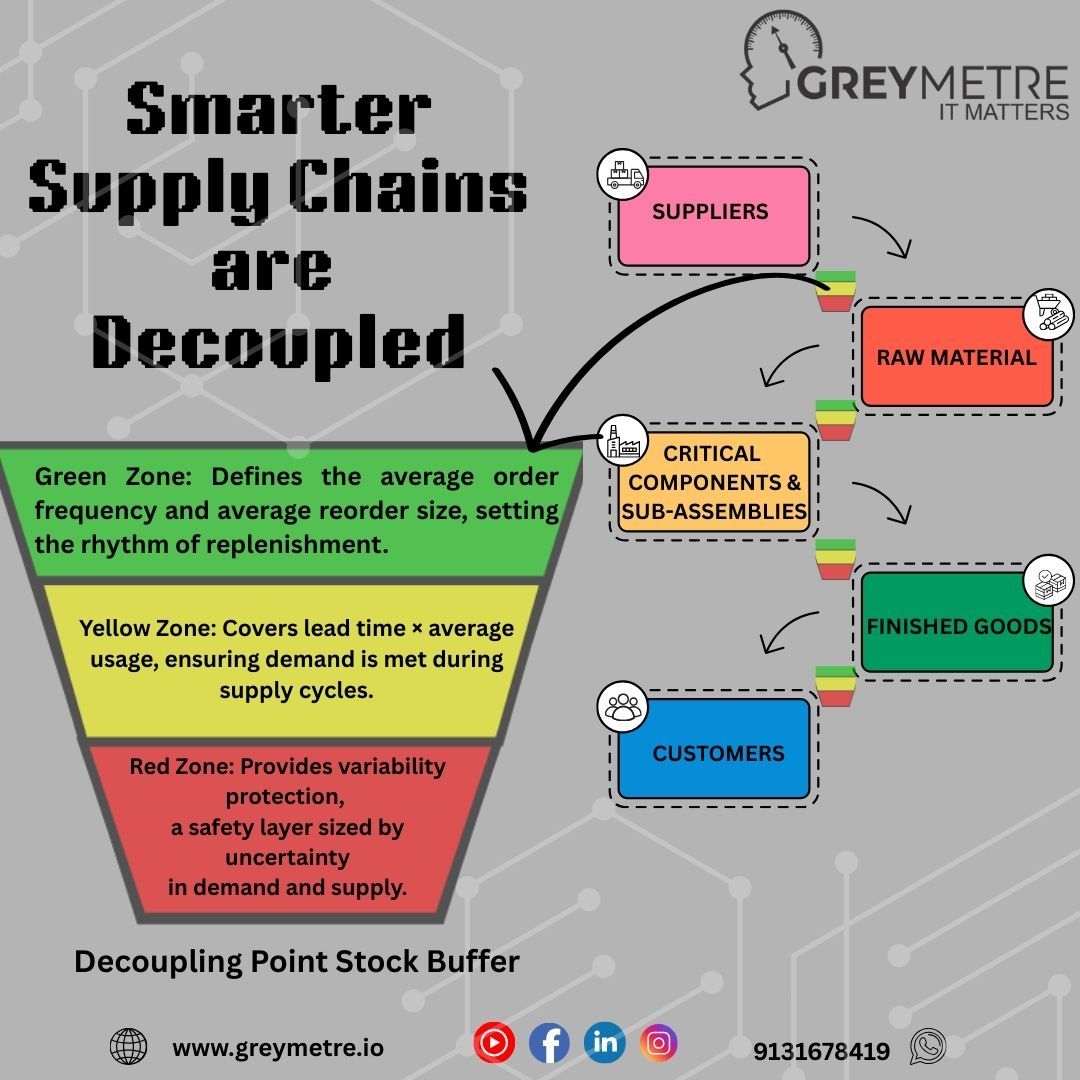
DDMRP achieves this by strategically embracing decoupling. Decoupling involves intentionally creating independence between processes or entities within the supply chain to effectively halt the transfer and amplification of variability. At these strategic "decoupling points”, independently planned and dynamically adjusted "decoupling point buffers" are maintained. These buffers are quantities of inventory strategically positioned to absorb both demand and supply variability, to be consumed and replenished only based on actual consumption. This ensures reliable availability while simultaneously aggregating demand orders, generating a more stable and efficient supply signal for upstream suppliers.
The DDMRP Mantra: Position, Protect, Pull
The essence of DDMRP is captured in its powerful mantra: "Position, Protect, Pull."
1. Position: Where to place your strategic inventory
"Position" refers to the strategic placement of decoupling points within your supply chain. This is not a tactical decision but a strategic imperative that profoundly influences service levels, working capital efficiency, expedite expenses, cash flow, and ultimately, your organization's return on investment. Key factors guiding this positioning include:
• Customer Tolerance Time: How long is your customer willing to wait? Shorter tolerance times often necessitate finished goods or critical components closer to the customer.
• Market Potential Lead Time: The lead time that could unlock significant market opportunities.
• Sales Order Visibility Horizon: The timeframe in which firm sales orders are typically known.
• External Variability: Both demand variability (frequency and severity of demand spikes) and variable rate of supply (potential for supplier disruptions).
• Inventory Leverage and Flexibility: Locations where inventory can serve multiple end items or provide flexibility across product lines (e.g., common components).
• Critical Operation Protection: Safeguarding key operational areas like bottlenecks or points where variability tends to accumulate.
Advanced considerations include the Decoupled Lead Time (DLT), a novel form of lead time that emerges with strategic decoupling, compressing overall lead times and accurately setting buffer levels. This strategic positioning can even lead to optimized distribution networks, such as a "hub-and-spoke" model, reducing total inventory while improving service.
2. Protect: How to size your adaptive buffers
"Protect" denotes the meticulous sizing of the buffers at these decoupling points to effectively absorb anticipated variability. These strategic buffers form the very "heart of the planning system" in DDMRP. A critical philosophical shift here is viewing inventory as a true asset when properly placed and sized, providing a tangible return by promoting flow and acting as a resilient "break wall" against variability. DDMRP employs dynamic, three-zone buffers for replenished parts:
• Green Zone: Determines average order frequency and typical order size, ensuring consistent supply order generation.
• Yellow Zone: The "rebuild zone," providing demand coverage for one full decoupled lead time, allowing time for a new supply order to be generated and received.
• Red Zone: Represents the embedded safety stock, designed to absorb variability, with its size proportional to the part's variability.
These buffers are designed to be dynamic, continuously adapting to changing conditions through recalculated adjustments (e.g., changes in Average Daily Usage) and Planned Adjustment Factors (e.g., for promotions, seasonality, product transitions). This adaptability makes them highly effective shock absorbers, proactively navigating through uncertainty.
3. Pull: Generating Supply Based on Actual Demand
"Pull" signifies the generation of supply orders based on actual, real-time demand signals, rather than relying on unreliable forecasts. This is a fundamental shift in planning.
The central calculation is the Net Flow Equation: On-hand + on-order – qualified sales order demand = net flow position. This equation is performed daily for each buffered position, providing a precise and real-time signal for replenishment.
Another key element is qualifying ‘Order Spikes’, significant quantities of known cumulative daily demand within a defined "order spike horizon" that, if unaddressed, would threaten buffer integrity. The entire amount of a qualified spike is incorporated into the net flow equation if within the order spike horizon.
The supply order generation logic is straightforward: if the net flow position falls below the Top of Yellow (TOY), a supply order is recommended to restore the net flow position to the Top of Green (TOG). This order is assigned a request date one decoupled lead time into the future. DDMRP also introduces decoupled explosion, stopping the Bill of Material (BOM) explosion at buffered decoupling points, simplifying planning and preventing nervousness from rippling through the entire BOM.
The Transformative Impact: Resilience and Predictability
By embracing "Position, Protect, Pull," DDMRP delivers profound operational and financial benefits:
• Dampened Bullwhip Effect: By absorbing variability at decoupling points, DDMRP prevents demand and supply fluctuations from amplifying across the supply chain.
• Reduced Nervousness: Decoupled planning segments prevent changes in one area from causing chaotic ripple effects throughout the entire system.
• Optimized Inventory: Strategic placement and dynamic sizing ensure "right" inventory, reducing working capital while maximizing availability.
• Improved Service Levels: Reliable material availability at decoupling points leads to consistent on-time delivery and enhanced customer satisfaction.
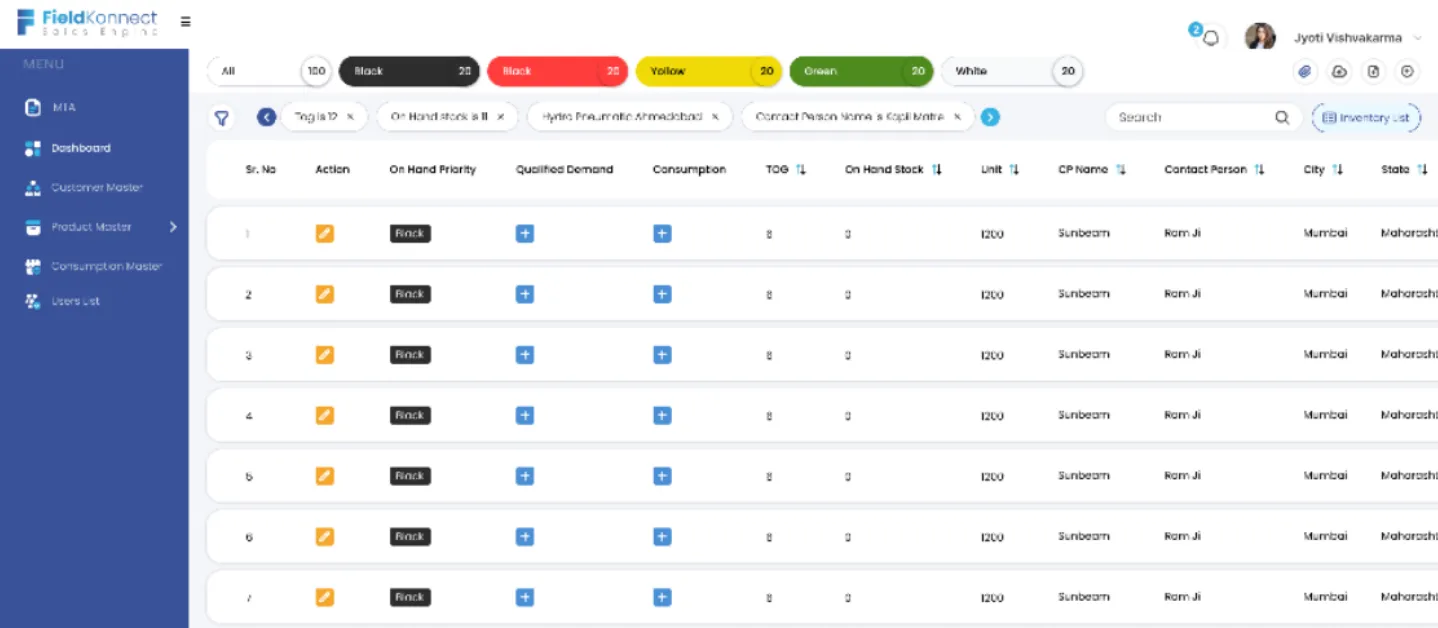
• Clearer Priorities: Intuitive, color-coded buffer statuses provide real-time, relative priority for open orders, empowering personnel to focus on the highest-priority actions.
• More Realistic Scheduling: DDMRP creates decoupled schedules, transforming large, complex puzzles into smaller, independent legs, and even offers a simple finite scheduling alternative akin to "drum scheduling."
The result is a supply chain that is not just efficient, but truly resilient and responsive, a critical competitive advantage in today's "New Normal."
Transform your supply chain from reactive to responsive.
Learn more about GreyMetre's DDMRP solutions and how they can bring predictable flow to your operations.
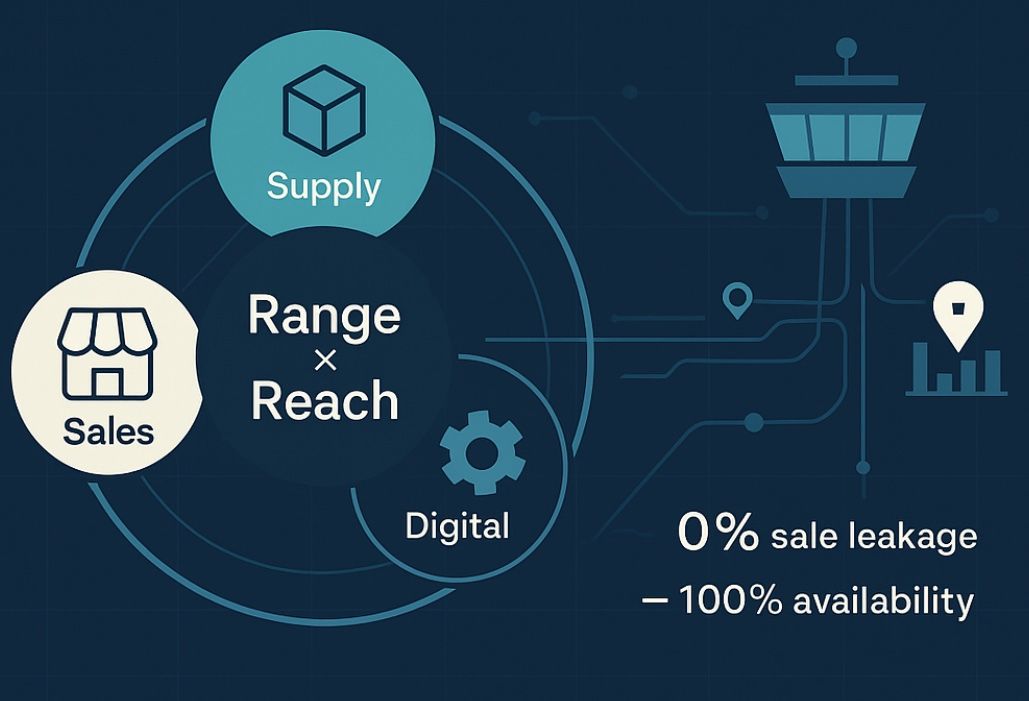
The true power of Greymetre's Sales Engine is realized through its seamless integration within our broader ecosystem of services. Optimized sales execution, powered by CRM, outreach, and productivity tools like FieldKonnect SFA, is coupled with better product availability, a direct benefit derived from our Demand Driven Material Requirements Planning (DDMRP) expertise. This synergy ensures that sales teams are not only effective in acquiring new business but also in retaining and growing existing customer relationships, ultimately plugging sales losses and creating sustained revenue growth.
By choosing Greymetre, you're not just investing in a sales solution; you're investing in a strategic partner committed to fundamentally re-engineering your B2B sales process to be more intelligent, targeted, and value-driven.
Take the Next Step-
Is your supply chain ready to move from reactive to responsive?
Experience how DDMRP and FieldKonnect can bring agility, predictability, and flow to your operations.
📅 Book a 30-minute Strategy Call : https://calendly.com/greymetre/30min
📝 Request a Custom Assessment via Google Form : https://docs.google.com/forms/d/e/1FAIpQLSd--fie3kRM3BQjGW0wivqQoyhM8BV4oG_rTYAJzAtZeYQ1_A/viewform?usp=sharing&ouid=110961036630935533366