In the relentless turbulence of today's global market, a supply chain's ability to absorb shock and adapt to change is its most critical asset. For decades, traditional Material Requirements Planning (MRP) and its reliance on static safety stock were the standard. However, in an era defined by extreme volatility and complexity, this rigid approach is a liability. Conventional planning systems, which treat inventory as a buffer against variation, are often brittle and incapable of handling the "New Normal". This leads to chronic stockouts and costly inventory imbalances, a phenomenon known as "too much of the wrong and too little of the right".
At Greymetre, we understand that true resilience isn't found in static systems, but in adaptive ones. The solution lies in Demand Driven Material Requirements Planning (DDMRP) and its revolutionary approach to inventory: Strategic Buffers. These aren't just quantities of stock; they are the heart of the planning system, meticulously designed to act as proactive shock absorbers that continuously flex to absorb demand and supply variability.
The Three-Zone Structure: A Blueprint for Resilience
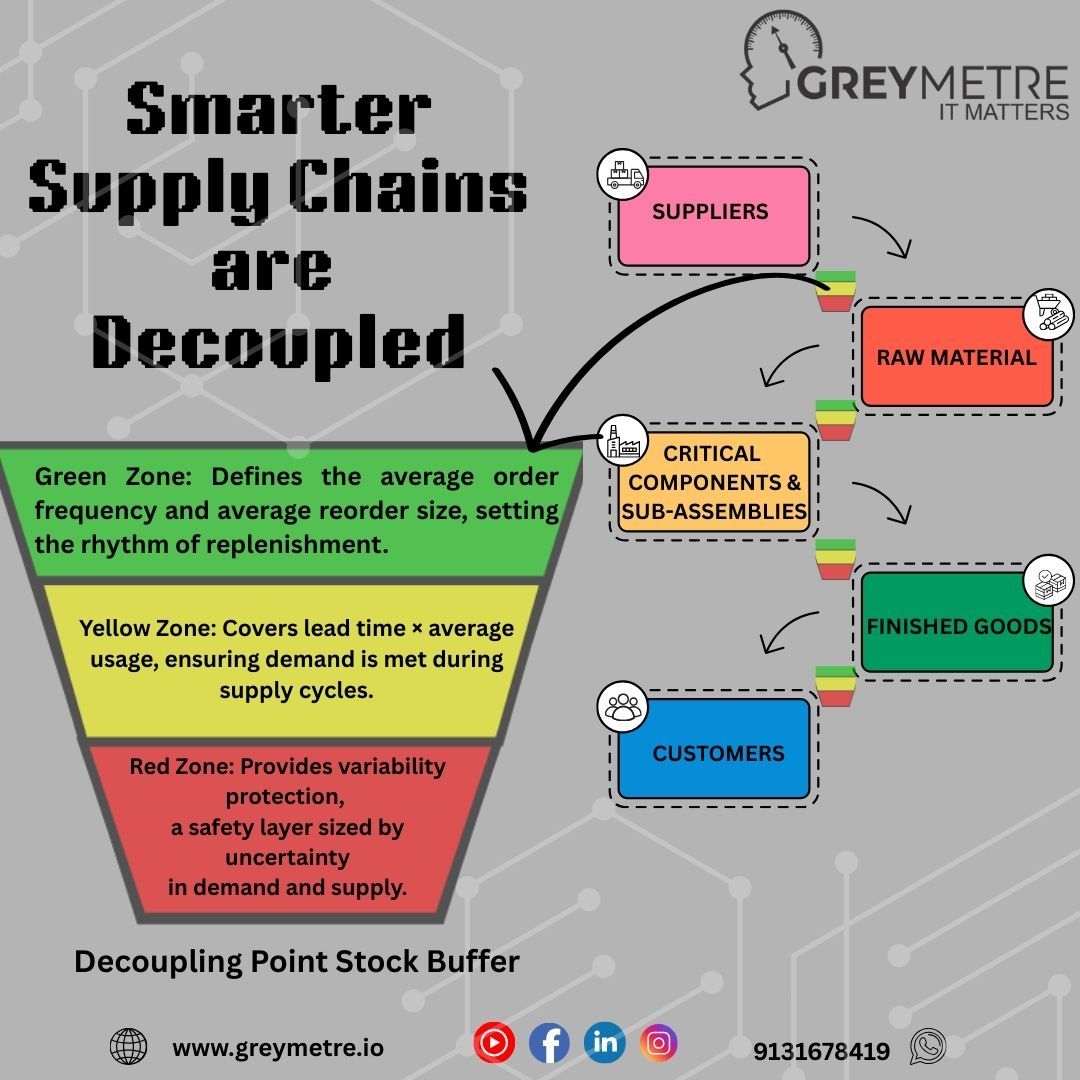
DDMRP's strategic buffers are defined by a unique and intuitive three-zone structure. Each color-coded zone serves a specific, critical purpose, allowing for precise control and visibility that far surpasses the capabilities of conventional safety stock mechanisms .
The Green Zone (Supply Order Generation): This is the top layer of the buffer and is the engine of supply order generation . It defines the average order frequency and typical order size, ensuring that replenishment signals are clear and consistent. Its size is determined by the largest value of three factors: an imposed order cycle, a lead time factor applied to average daily usage (ADU), or a significant minimum order quantity (MOQ). This ensures that supply orders are generated efficiently while respecting operational and commercial constraints.
The Yellow Zone (Demand Coverage): Known as the "rebuild zone," this middle layer provides crucial demand coverage for one full decoupled lead time (DLT). The decoupled lead time is a powerful new metric that represents the longest cumulative coupled lead time chain in a product's structure, assuming components at decoupling points are readily available. The Yellow Zone is calculated as Decoupled Lead Time × Average Daily Usage (ADU), providing a protective shield that buys the system enough time to receive a new supply order.
The Red Zone (Safety & Variability Absorption): This is the lowest level of the buffer, representing the embedded safety stock . The Red Zone is your ultimate defense against unexpected volatility. Its size is directly proportional to a part's variability, ensuring a larger cushion for parts with a higher potential for disruption. The Red Zone is calculated through a two-step sequence involving a "red base" and a "red safety" component, which accounts for both lead time and variability factors.
The Adaptive Power: Dynamic Adjustments as a Proactive Shield
What truly sets DDMRP's buffers apart from conventional planning is their ability to dynamically adjust and adapt. Today’s supply chains are not static, and neither should their protection levels be. DDMRP enables buffers to flex continuously in response to changing conditions, minimizing the "accelerating mistakes" of rigid planning.
Adjustments can occur through two primary mechanisms:
- Recalculated Adjustments: These are automated adjustments to buffer levels triggered by changes in individual part attributes or modifications to buffer profiles. For example, a significant change in a part’s Average Daily Usage (ADU), a compression in its Decoupled Lead Time (DLT), or an alteration to its Minimum Order Quantity (MOQ) will automatically trigger a recalculation, ensuring the buffer's protection level remains appropriate.
- Planned Adjustment Factors (PAFs): These are manual manipulations of the buffer equation, implemented based on strategic decisions, historical patterns, or specific business intelligence. PAFs allow for proactive adjustments to inventory positions by raising or lowering buffer levels and their corresponding zones at predetermined points in time.
- Demand Adjustment Factors (DAF): Used for situations such as planned promotions, seasonal demand fluctuations, product transitions (ramp-up for new products, ramp-down for deletions), or in response to rapid changes in demand.
- Zone Adjustment Factors: Allow for direct manipulation of the Green, Yellow, or Red zones to accommodate larger, less frequent orders or account for a known, short-term increase in supply volatility.
- Lead Time Adjustment Factors: Applied when there is a planned or known expansion of lead times for a group of items, such as due to a major transportation disruption.
This inherent adaptability transforms DDMRP buffers into highly effective shock absorbers. Unlike traditional safety stock, which remains static and can inadvertently amplify demand signal distortions, DDMRP's buffers are designed to actively manage uncertainty. This proactive posture is crucial for minimizing compounding errors in volatile environments and ensuring continuous resilience and responsiveness.
The Greymetre Advantage: Enabling a Resilient, Adaptive Supply Chain
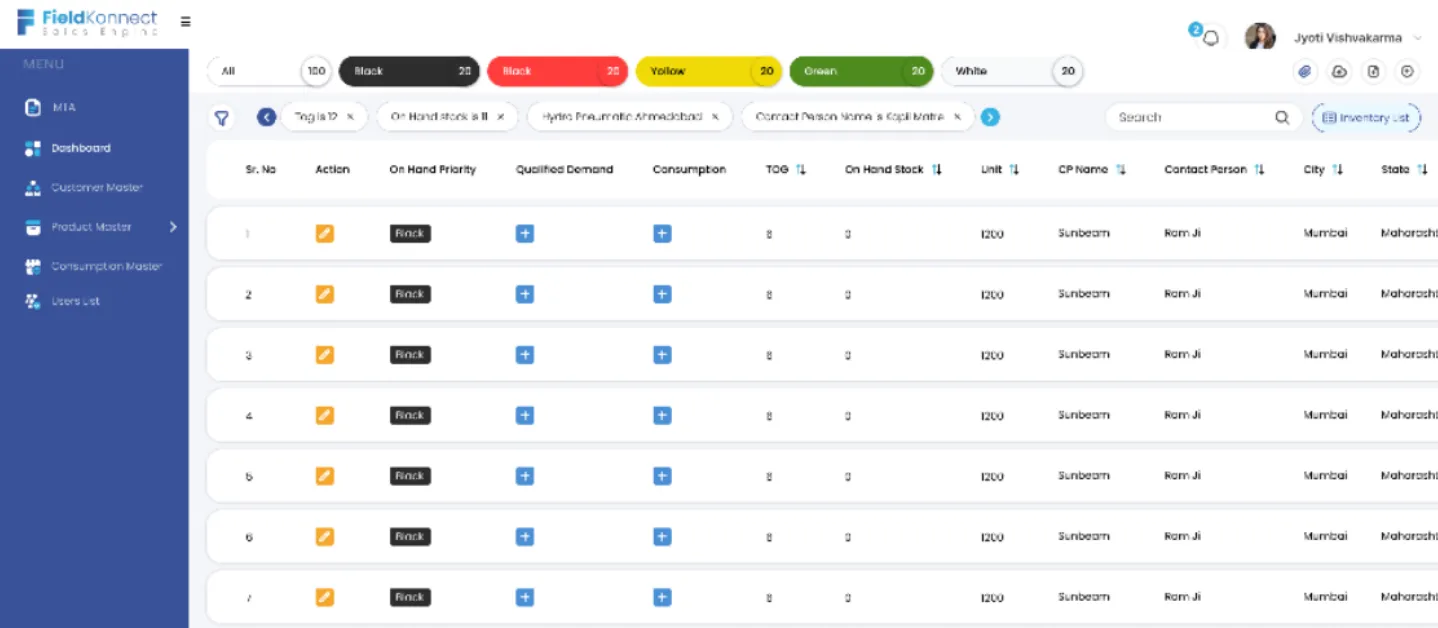
The mechanics of DDMRP's strategic buffers, with their color-coded zones and dynamic adjustments, are what enable an organization to shift from a reactive to a resilient state. They provide intuitive, real-time signals for both planning and execution, allowing personnel to make focused, data-driven decisions that promote the flow of materials and protect against volatility.
At Greymetre, our Demand-Driven Business Transformation services are built on the foundational principles of DDMRP. We partner with you to implement this adaptive framework, ensuring your buffers are not just sized correctly but are also continuously managed to maintain operational agility and financial performance.
Supply chains don’t wait, and neither should you.
Fill out this short form https://lnkd.in/eMhi5m8W with your details and let’s start discussing how to make your operations more resilient.